
SEO vs GEO vs AEO vs AIO: What Actually Works in 2026?
Four acronyms, one job. SEO, AEO, GEO, and AIO all describe getting found: across Google's ranked links, its answer boxes, and now inside AI assistants like ChatGPT and Perplexity. They overlap far more than the labels suggest, and Google's own 2026 guidance calls the whole exercise "still SEO." What follows is what's proven, what's oversold, and what to do.
The 60-second decoder
Strip away the marketing and the four terms describe four overlapping targets, not four separate jobs.
| Term | Full name | What it targets | New skill, or rebrand? |
|---|---|---|---|
| SEO | Search Engine Optimization | Ranking in Google and Bing's results | The foundation everything sits on |
| AEO | Answer Engine Optimization | The direct-answer slot: featured snippets, voice, zero-click boxes | A subset of SEO and GEO |
| GEO | Generative Engine Optimization | Getting cited inside an AI answer (ChatGPT, Perplexity, AI Overviews) | The genuinely new layer |
| AIO / LLMO | AI / LLM Optimization | Making content machine-readable for language models | Mostly an umbrella term |
There is no settled definition for any of them. As of early 2026, Wikipedia's own entry notes the terms are used interchangeably: GEO, AEO, AIO, and LLMO all point at roughly the same idea. The distinctions are real but narrow, and the tactics behind them overlap almost entirely.
Why anyone is talking about this
The acronyms multiplied because search behaviour genuinely changed. People increasingly get their answer on the results page (or inside a chatbot) and never click through.
The numbers are hard to wave away. In the first four months of 2026, 68% of Google searches ended without a click, according to Rand Fishkin's analysis of Similarweb data at SparkToro, up from about 60% in 2024. And where Google shows an AI Overview, the effect is sharper: the first randomized field experiment on AI Overviews, run by researchers at the Indian School of Business and Carnegie Mellon in early 2026, found they cut organic clicks on triggered queries by 38%, with zero-click rates jumping from 54% to 72%.
So the shift is real. That is exactly why it attracts noise.
What's oversold, and what holds up
Wherever a real shift meets an unclear playbook, a market for shortcuts appears. A handful of claims now circulate as must-do "GEO" or "AEO" tactics:
- Buy a packaged "AI-citation" service to get mentioned by ChatGPT.
- Add an
llms.txtfile so AI engines know how to read your site. - "Chunk" your content into AI-friendly blocks.
- Bolt on schema markup specifically to win AI answers.
None of these is a scandal. They are reasonable-sounding guesses at a system nobody fully documents. The problem is that when you check them against what the engines actually say, most do not hold up. So check them.
What Google actually says
Google published its position in 2026, and it is blunter than the marketing around it. From the official Search Central guide to generative AI features:
From Google Search's perspective, optimizing for generative AI search is optimizing for the search experience, and thus still SEO.
The same document quietly dismantles several of the popular tactics above:
llms.txtfiles: "Google Search itself doesn't use them."- Content "chunking": not required; Google's systems already parse multiple topics on a page.
- Special structured data: "Structured data isn't required for generative AI search."
- Extra long-tail keyword variants: unnecessary; you don't need to manufacture more of them.
- Inauthentic mentions: ineffective, and they run into Google's spam policies.
What Google says does matter is unglamorous and familiar: unique, genuinely useful content that isn't a commodity rehash; a site that is crawlable and technically sound; a good page experience. In other words, the SEO fundamentals, not a new acronym.
But Google only speaks for Google
Here is the honest counterweight, because it is easy to over-correct into "so it's all just SEO, ignore the rest."
Google's guidance describes Google's systems. ChatGPT, Perplexity, Gemini, and Google's own AI Mode do not all select sources the same way, and several of them lean noticeably on live retrieval: clear structure, freshness, and explicit citations. A passage written to be lifted cleanly, with its facts sourced, genuinely does earn citations on those surfaces, even where Google shrugs at the same techniques. The work is real; it is just not a separate product from good SEO writing.
What's actually proven to work
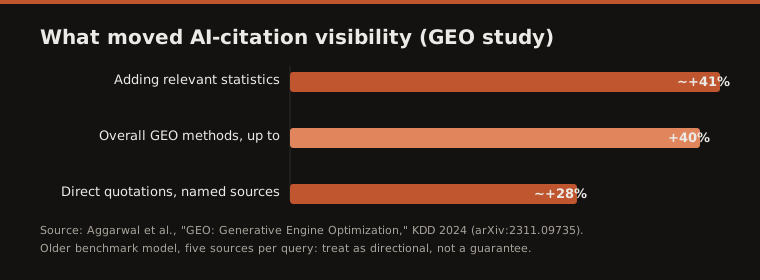
The most rigorous evidence comes from the paper that named the field. In GEO: Generative Engine Optimization (KDD 2024), Aggarwal, Murahari, Rajpurohit, Kalyan, Narasimhan, and Deshpande built a benchmark of thousands of queries and tested which content changes increased a source's visibility inside AI-generated answers. Their headline result: GEO methods "can boost visibility by up to 40% in generative engine responses."
The levers that moved the needle were not tricks. One analysis of the study's results put the biggest gains on adding relevant statistics (around +41%) and direct quotations from named sources (around +28%), with citing sources helping most for pages that started with low visibility. Two things the same body of work found actively hurt: keyword stuffing and heavy-handed meta-tag manipulation. If that sounds like plain good writing (specific, sourced, quotable) that is the point.
For a single page, that translates into a short, boring, effective checklist:
- Answer the question in the first 40 to 60 words, so the passage stands on its own.
- Back every claim with a named, dated source: the single most reliable lever in the research.
- Structure for extraction: tables for comparisons, numbered lists for steps, a real FAQ.
- Cut the promotional filler. "Industry-leading" adds nothing a model wants to quote and, in these studies, correlates with lower citation.
What's weak, and the problem nobody sells you
Now the caveats the excited version leaves out.
The Princeton numbers are real but fragile. The test ran on an older model (GPT-3.5-era) and pitted only five candidate sources against each other per query, a setup that amplifies relative gains and used AI-generated edits rather than human ones. Treat "up to 40%" as directional, not a figure to put in a proposal.
The deeper issue is measurement. When ChatGPT mentions your brand, you usually cannot see it, cannot attribute a sale to it, and cannot prove the ROI the way you can with a ranking and a click. There is no clean, universal "share of AI voice" yet. That gap (real shift, no reliable meter) is precisely the vacuum that hype rushes to fill. The honest answer is to measure what you can: filter GA4 for referrals from chatgpt.com and perplexity.ai, and watch Google Search Console's generative-AI performance report. Small, real signals beat a confident number that means nothing.
The MENA opening most people are ignoring
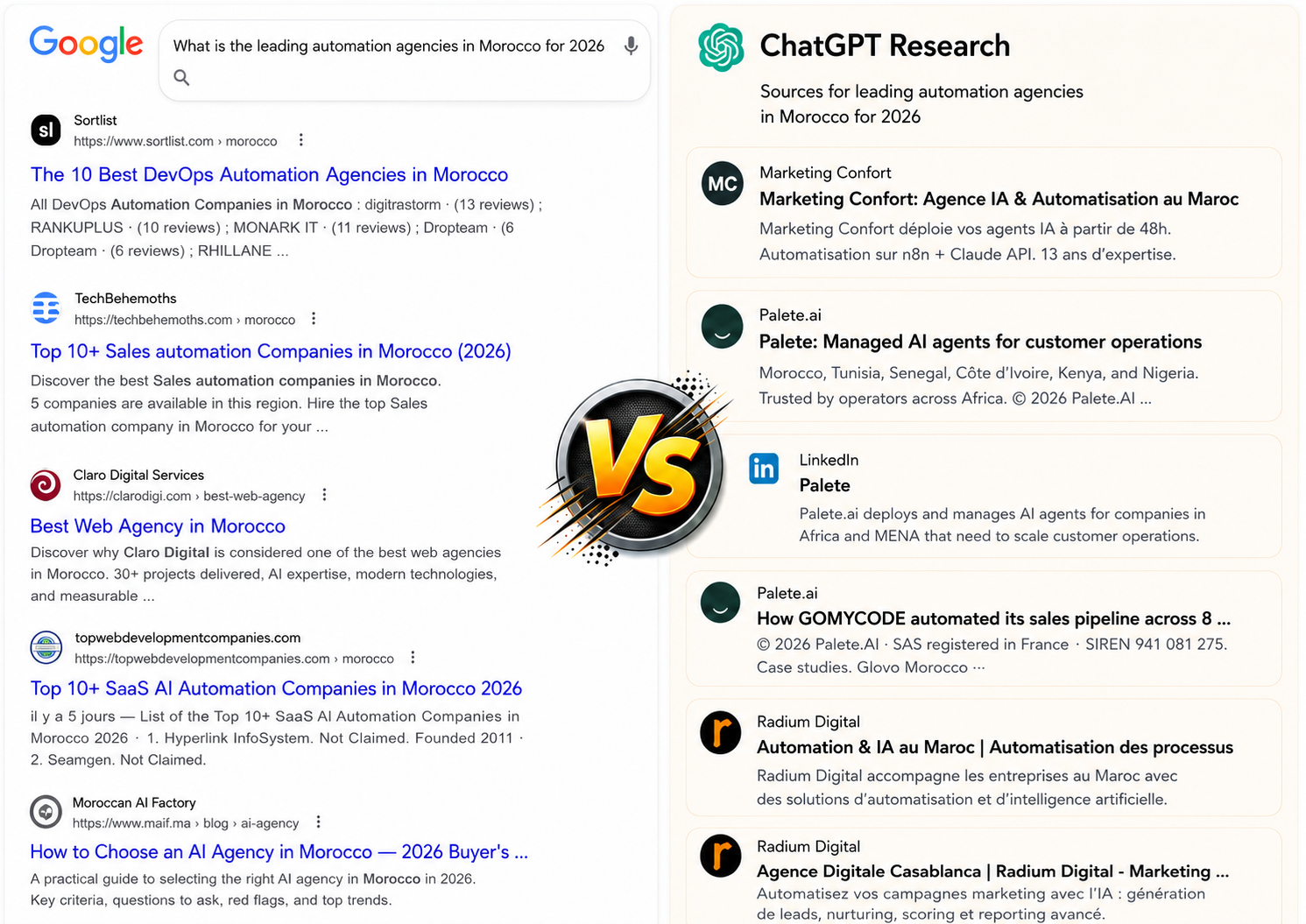
For businesses in Morocco and the wider region, there is a specific, unhyped advantage here, and the comparison above shows it in miniature. Asked for the leading automation agencies in Morocco, Google returns international directories to scroll through, while ChatGPT reaches straight past them for specific local agencies, several of them French-language pages, as its cited sources. Language models handle Arabic (and, for Morocco, French) less comprehensively than English, which means far less competition for citations in those languages. A well-sourced Arabic or French page can become the source an AI reaches for, in a space English-first competitors are not even contesting.
Two practical notes from working in this market. For Moroccan B2B and tech topics, French is at least as important as Arabic, while consumer and local queries lean toward Darija, so test your priority questions in all three, not just English. And freshness matters more than most expect: by one 2026 analysis, roughly half of the content AI engines cite is under 13 weeks old. Publishing consistently in an underserved language is a rare case where the opening is wide and the effort is low.
What to actually do
You do not need four strategies, four budgets, or a "GEO package." One integrated approach covers all of it:
- Fix the foundation first. If an AI engine cannot crawl and parse your page, none of the rest matters. It can only cite what it can read.
- Write the proven levers in: front-loaded answers, named and dated sources, extractable structure, no promotional filler.
- Skip the hacks the platform owners have already dismissed:
llms.txt, keyword stuffing, "AI-only" schema, bought mentions. - Measure honestly with the signals you actually have, and treat every citation-rate statistic as perishable.
This is the discipline we bring to content at Media Targeters: go to the primary source, separate the proven lever from the sales pitch, and build systems that publish sourced, structured, genuinely useful pages at scale: the kind engines rank and quote. If you want that applied to your own site or market, see what we build or start a conversation.
The acronyms will keep multiplying. The work underneath them barely changes: be the clearest, best-sourced answer to a real question, and be readable by the machines now doing the answering.
Sources
- Google Search Central: Optimizing for generative AI features on Google Search (official documentation, 2026). developers.google.com
- Aggarwal, Murahari, Rajpurohit, Kalyan, Narasimhan & Deshpande: GEO: Generative Engine Optimization, KDD 2024. arxiv.org/abs/2311.09735
- Blck Alpaca: The Princeton GEO Study: Methodology, Results and Critique (analysis of the study's per-method results and limitations). blckalpaca.at
- Rand Fishkin / SparkToro: In 2026, Less than One Third of Google Searches Still Send a Click, 9 June 2026 (Similarweb US panel, Jan to Apr 2026). sparktoro.com
- Search Engine Journal: Study Confirms Google AI Overviews Cut Organic Clicks 38% (Agarwal & Sen field experiment, ISB / CMU, early 2026). searchenginejournal.com
- SEOManiak: GEO vs SEO: la différence en 2026 (MENA/Morocco context and AI-cited-content freshness). seomaniak.ma
- Wikipedia: Generative engine optimization (on the interchangeable use of GEO / AEO / AIO / LLMO). en.wikipedia.org
Frequently asked questions
SEO ranks your page in classic search results. AEO wins the direct-answer slot: snippets and voice. GEO gets your content cited inside AI answers like ChatGPT or Perplexity. AIO, or LLMO, is the umbrella term for making content readable by AI. They overlap heavily and share one foundation: a crawlable, useful page.
You need one integrated approach, not four budgets. Google states that optimizing for AI search 'is still SEO.' A crawlable, well-structured, genuinely useful page earns classic rankings and AI citations at the same time. The GEO and AEO work is refinement (clearer answers, sourced facts), not a separate discipline.
Partly, and with caveats. A Princeton-led study found GEO methods lifted content visibility in AI answers by up to 40% in a controlled test. But it used an older model and only five competing sources per query, so treat the exact numbers as directional, not a guarantee you can resell.
Not for Google. Google's 2026 documentation states plainly that Google Search itself doesn't use llms.txt files. A few tools may read them, but there's no evidence they change what major engines cite. The effort is better spent on crawlable, well-sourced content.
Ready to automate the work?
Media Targeters builds custom agentic AI systems that run your operations while you focus on growth.
Book a discovery callRelated Articles

Morocco Real Estate 2026: Boom, Crash, or Neither?
Is Morocco's real estate market booming or crashing in 2026? Bank Al-Maghrib data shows a 40% Q1 transaction drop, but the yearly picture is milder.

Why Agentic AI Projects Fail (5 Questions First)
Gartner expects over 40% of agentic AI projects canceled by 2027: not weak models, weak governance. Five questions predict which ones survive.
AI-Native SaaS Architecture: The 2026 Blueprint
The monolith is out. AI-native SaaS architecture in 2026 runs on real-time data, reliable backend AI, and MCP: the protocol that carries apps into ChatGPT.
AI Agents vs Agentic AI: What's the Difference?
AI agents handle single tasks; agentic AI orchestrates them toward goals. Get the real difference, a side-by-side table, and which one your business needs.