
Is Morocco's Real Estate Market Booming or Crashing in 2026?
Neither, exactly. The Morocco real estate market cooled sharply in early 2026 but did not crash: official Bank Al-Maghrib data shows transactions fell 40.2% in the first quarter versus the previous one, while year-over-year residential sales were down just 10.7% and national prices held nearly flat at −0.4%. What's left is a cooling, splitting market, not a collapse.
The 40% everyone quotes is a single quarter
Two loud narratives are both getting the market wrong. Property blogs sell a "World Cup 2030 gold rush"; French-language headlines announce a historic collapse. Bank Al-Maghrib's own numbers support neither cleanly, and the gap between them is where the real read lives.
Start with the number itself. That alarming figure comes from the real-estate asset price index (IPAI) published jointly by Bank Al-Maghrib and the national land registry on June 23, 2026. It reported that transactions fell 40.2% in Q1 2026, but that number is measured against the fourth quarter of 2025, not against a year earlier. Property markets are seasonal, and a quarter-on-quarter drop from a busy end-of-year period is a different animal from a structural annual decline.
Line the two views up and the "crash" softens considerably:
| Metric | Quarter-on-quarter (Q1 2026) | Year-over-year |
|---|---|---|
| Transactions (residential) | −38.4% | −10.7% |
| Price index (national) | −2.4% | −0.4% |
| Land transactions | −45.9% | n/a |
A residential market down 10.7% on sales and essentially flat on price over twelve months is a slowdown. It is not the 40% freefall the number gets quoted as. Both figures are true; only one describes the trend.
Where the market is genuinely falling
Averages hide the real movement, which is uneven across cities and segments. Q1's sharpest contractions landed on the administrative capital and on land and villas (the speculative end of the market) rather than on entry-level housing.
| City | Price change | Transaction change |
|---|---|---|
| Rabat | −4.7% | −55.4% |
| Marrakech | −1.5% | −51.5% |
| Casablanca | −2.7% | −37.8% |
| Tangier | −3.9% | −36.4% |
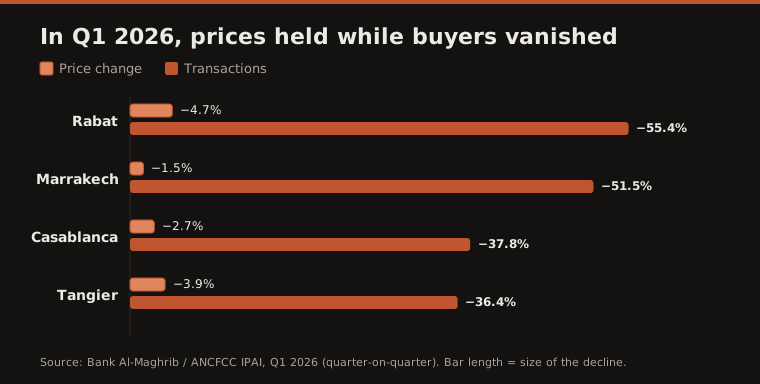
By property type, villas led the transaction decline at −53.1% quarter-on-quarter and land at −45.9%, according to the same Bank Al-Maghrib release. Apartments (the segment most families actually buy) fell 37.5%, meaningfully less than the headline suggests. When investors pull back, the froth goes first.
Why it isn't a crash, either
Now the half the collapse headlines skip. Over a full year, national prices barely moved: the IPAI was down just 0.4%, not the double-digit drop the transaction figure implies. Offices were the only segment to gain ground, up 2% year-over-year. And in Marrakech, prices slipped only 1.5% even as transactions halved, which tells you sellers held their asking prices while buyers waited on the sidelines rather than cutting to move stock.
Developers read it the same way. Taoufik Kamil, president of the National Federation of Real Estate Developers (FNPI), told Moroccan press in March 2026 that he expects a more rational market driven by real production costs rather than speculation:
2026 should bring neither a price surge nor a brutal correction, just contained growth of between 2% and 5% nationally. Taoufik Kamil, President, FNPI
So the "boom" camp isn't hallucinating. They see firm prices and steady prime demand and call the whole thing hot. Both camps mistake one signal for the entire picture. A frozen transaction count and a nearly flat price index describe the same reality: buyers paused, sellers stood firm, and not much actually changed hands.
Why buyers and sellers stepped back: six rule changes
Seasonality explains part of the quarterly drop. Policy explains the rest. Over the past two years Morocco tightened the rules around building and transacting, and the friction shows up directly in transaction counts. As L'Économiste reported, six changes stand out:
- A doubled land tax. The annual levy on undeveloped urban land jumped from 15 to 30 MAD/m², making it markedly more expensive for owners and developers to sit on an empty plot while they wait for a better price.
- The 60 m² studio ban. Casablanca and Rabat now prohibit studios under 60 square meters, a rule aimed squarely at the short-term-rental speculation the 2030 build-up was fuelling.
- Mandatory tax clearance. Every sale now needs a "quitus fiscal" before it can close.
- The end of private deeds. The ban on informal "actes sous seing privé" routes each transaction through formal notarial channels, stretching timelines that were already slow.
- Permit complexity. Layered construction-authorization procedures keep choking new supply in the big cities.
- Scarce, costly land. Buildable urban land is in short supply and expensive.
Read together, several of these are deliberate cooling measures: the government throttling speculation while it builds toward the World Cup. This isn't only demand evaporating. Some of it is policy working as intended.
What this means if you're buying in 2026
The headline number is the wrong thing to act on. A buyer who reads "40% crash" and waits for a bottom will misread a market where prices barely moved; a buyer who reads "World Cup boom" and overpays in Rabat will ignore a city that just handed sellers a 55% drop in willing buyers and real room to negotiate. There is no national signal here, only the city, the segment, and the calendar.
That's the discipline we bring to every market question at Media Targeters: go to the primary source, separate the quarter from the year, and let the segmented data overrule the tidy story. We build the automated research and reporting systems that do exactly this at scale: pulling official figures, not affiliate summaries. If you want that kind of grounded analysis applied to your own market or dataset, see what we build or start a conversation.
Morocco's property market in 2026 is neither the gold rush nor the collapse it gets sold as. It's a market rewarding people who read past the first number.
Sources
All transaction and price figures come from the Q1 2026 real-estate asset price index (IPAI) compiled jointly by Bank Al-Maghrib and the national land registry (ANCFCC), as reported by the Moroccan press below.
- Bank Al-Maghrib & ANCFCC: Indice des prix des actifs immobiliers (IPAI), Q1 2026 release. bkam.ma
- Lebrief.ma: "Immobilier : fort ralentissement au premier trimestre 2026," 23 June 2026 (full IPAI breakdown, quarter-on-quarter and year-over-year, with the per-city table). lebrief.ma
- Le360: "Immobilier : les transactions s'effondrent de 40% face à une crise sans précédent," June 2026 (segment breakdown by villas, houses, and apartments). fr.le360.ma
- Consonews.ma (relaying L'Économiste): "Immobilier : chute de 40% des ventes, du jamais vu !," 6 July 2026 (the regulatory causes behind the slowdown). consonews.ma
- Telquel.ma: "Immobilier : des perspectives globalement favorables en 2026," 9 March 2026 (FNPI president Taoufik Kamil's forecast). telquel.ma
Frequently asked questions
No. Bank Al-Maghrib reported transactions down 40.2% in Q1 2026, but that figure is versus the previous quarter. Year-over-year, residential sales fell 10.7% and national prices were nearly flat at −0.4%. The market is cooling, not collapsing.
The 40.2% drop is a quarter-on-quarter figure, so seasonal slowdown is part of it. The rest traces to regulatory friction: a doubled tax on undeveloped urban land, a ban on studios under 60 m² in Casablanca and Rabat, and mandatory tax-clearance paperwork that lengthened deals.
The developers' federation (FNPI) forecasts contained national growth of 2% to 5% for 2026, calling for neither a surge nor a crash. Official data backs a stable picture: prices were down just 0.4% year-over-year in Q1 2026, with offices the one segment actually rising, up 2%.
It depends on the city and segment. Buyers gain negotiating room where sales froze: Rabat saw transactions fall 55.4% quarter-on-quarter. But prices held firm across most markets, so this is a cooling, not a fire sale. Read the segment data, not the national headline.
Ready to automate the work?
Media Targeters builds custom agentic AI systems that run your operations while you focus on growth.
Book a discovery callRelated Articles

SEO vs GEO vs AEO vs AIO: What Works in 2026
SEO, GEO, AEO, AIO: four acronyms, one job. What Google's own 2026 docs confirm, what the research proves, and which AI-search tactics are just hype.

Why Agentic AI Projects Fail (5 Questions First)
Gartner expects over 40% of agentic AI projects canceled by 2027: not weak models, weak governance. Five questions predict which ones survive.

AI-Native SaaS Architecture: The 2026 Blueprint
The monolith is out. AI-native SaaS architecture in 2026 runs on real-time data, reliable backend AI, and MCP: the protocol that carries apps into ChatGPT.

AI Agents vs Agentic AI: What's the Difference?
AI agents handle single tasks; agentic AI orchestrates them toward goals. Get the real difference, a side-by-side table, and which one your business needs.